AI Artist, AI Coder: Who Is Threatened by “Layoffs” from a Giant Neural Network?
Hi, friends! Let’s talk about a topic that makes everyone who earns with ideas a little nervous. You look at neural networks — and your heart skips a beat. You type a prompt — and here’s an image in the style of the Mona Lisa holding an avocado. You write “create code for a one-page website” — and, miraculously, it works.
And a thought instantly appears in your head: “That’s it. The end. Why pay a designer, copywriter, or programmer anymore? Any schoolkid can create now!” Sound familiar? I’ve been through that too.
But let’s take a breath and turn on logic instead of panic. After long reflection (and a cup of strong coffee), I came to a conclusion that gave me hope. And now I want to share it with you.
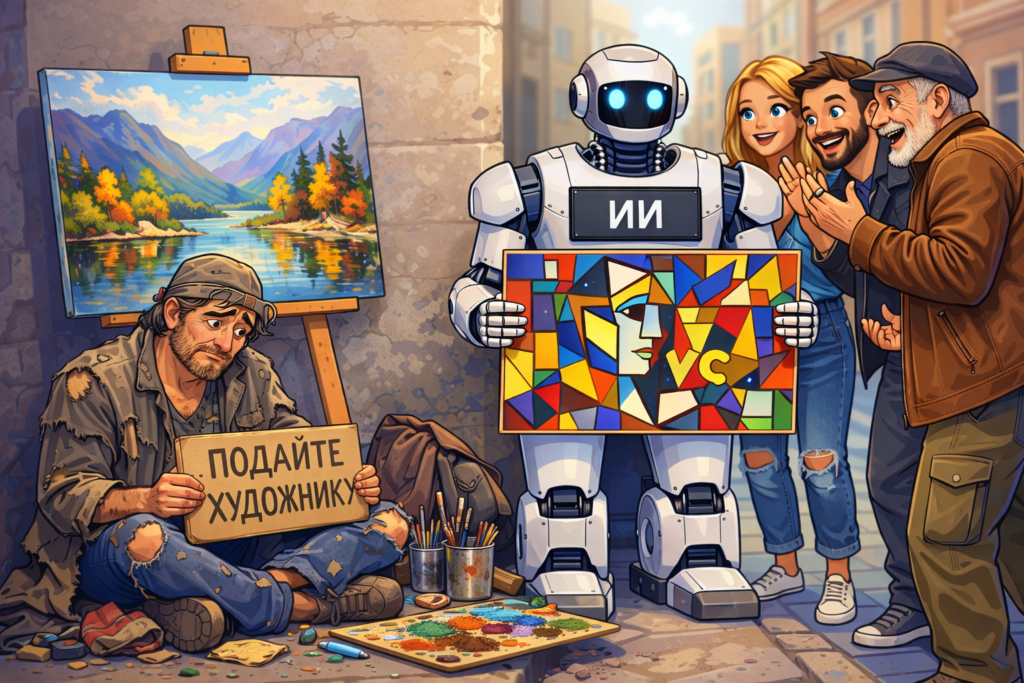
A short philosophy to start with: artificial intelligence is not a rival — it is the fastest and most tireless apprentice in human history. The real question is whether you remain the master in your workshop or hand over all the tools to it.
Scare #1: “AI will replace all programmers!”
The truth is that AI is a brilliant coding intern. It will happily write a piece of code you’ve written a hundred times before. It will spot a silly bug your eyes have already missed. It will translate code from Python to JavaScript. Sounds like a dream!
But imagine you’re building not a shed, but a spaceship. Your intern can perfectly cut bolts, but designing the engine, calculating loads, and making decisions in emergency situations is beyond its level. The human programmer is now an architect and chief engineer. Their job is to see the whole system, understand how it will scale, and adapt it to the needs of real, often demanding users. AI takes over routine work, freeing time for complex thinking.
Scare #2: “Now everyone is an artist! Designers are no longer needed!”
Yes, Midjourney and DALL·E work wonders. But generating an image from a prompt is not the same as design. Design is problem-solving. A logo is not just a pretty picture — it’s the embodiment of a brand’s philosophy. An interface is not a set of buttons — it’s a carefully designed user journey.
The human artist is now an art director and conceptual thinker. They create worlds, styles, and stories. They know how to evoke the right emotions in an audience. AI, in turn, is their incredibly talented and fast executor, capable of producing 100 background variations for that story in a minute.
A thought-provoking question: if an AI-generated artwork wins the main prize in an art competition, who should receive the award? The person who came up with the idea and wrote the prompt, or the developer of the model trained on millions of works by real artists? For now, there are more questions than answers.
Scare #3: “AI writes better than any copywriter!”
It really does write a lot and very fast. News, product descriptions, posts — it can handle all of that. But the voice of AI is like a very polite yet faceless secretary. It has no experience, passion, or unique worldview.
A human writer is a guide for meanings and emotions. They can infuse irony, sarcasm, or nostalgia into a text. They write in a way that makes you want to read, not just scroll. Their task now is to edit, enliven, and “humanize” AI-generated text, adding that special spark an algorithm can’t grasp.
So what’s the bottom line? Who will neural networks replace?
Here’s the main idea that calmed me down. AI is ruthless toward templates. It will replace:
-
icon drawers, not interface designers;
-
rewrite copywriters, not authors with a strong voice;
-
builders of simple websites, not developers of complex digital products.
Value is shifting. Before, you were valued for the ability to do. Now you will be valued for the ability to decide what should be done — and to perfect what AI starts. The most in-demand skill of the future is being a “pilot” for artificial intelligence in your field: understanding both your domain and how to explain tasks to a machine.
So, dear creators, designers, programmers, and everyone who works with ideas — it’s not time to panic. It’s time to reboot. Time to throw routine out of your work and focus on what makes us human: creativity, strategy, emotions, and meaning.
What do you think? Do you feel AI is a threat, or a powerful tool you’re already using? Who do you feel like now in this new tandem — the “master” or the “apprentice”?
Share your thoughts in the comments — it’s a fascinating discussion!
P.S. This article was carefully edited by a human after a dialogue with AI. Irony of fate, isn’t it?
Latest posts in this category
- Run Little One: Alien Dash – The Most Addictive Arcade of 2026 244
-
 Maze Monster Game Review: Thrilling Mazes on Android
165
Maze Monster Game Review: Thrilling Mazes on Android
165
-
 How to Write Proper Prompts for AI or why “Write an article” means nothing
215
How to Write Proper Prompts for AI or why “Write an article” means nothing
215
-
 Website Theft and Copyright Protection: My Fight for BlogGood (Part 1)
216
Website Theft and Copyright Protection: My Fight for BlogGood (Part 1)
216
-
 HTML5 vs. HTML4: The Evolution That Reshaped the Web
249
HTML5 vs. HTML4: The Evolution That Reshaped the Web
249


Leave a Reply